Upon your arrival at the airport, our company representative will warmly greet you and ensure your smooth transfer to the hotel. At the hotel, you will have the opportunity to meet our team. We will organize a pre-trek briefing in the evening, between 6:00 and 7:00 p.m. This gathering is an excellent opportunity to become acquainted with the other members of your group before we all proceed to enjoy a delicious dinner. The welcome dinner will feature authentic Nepalese cuisine and captivating cultural dance performances, immersing you in Nepal's rich cultural traditions.
Transfer: 30-45 min |
Accommodation: Hotel |
Meal: Welcome Dinner
Today, you will have the opportunity to explore Kathmandu with our experienced city tour guide. Our itinerary includes several remarkable sites:
- SWOYAMBHUNATH, also known as the Monkey Temple, is perched atop a hill and can be reached by climbing a long set of steps. From there, you can enjoy breathtaking panoramic views of Kathmandu.
- BOUDHANATH STUPA is adorned with traditional Gompas adorned with vibrant prayer flags. It serves as a focal point for Sherpas and Tibetans who partake in the spiritual practice of circumambulating the stupa (koras).
- PASHUPATINATH, a sacred Hindu temple, is situated on the banks of the Bagmati River and features ghats where cremation ceremonies take place, offering a unique glimpse into Hindu rituals.
- KATHMANDU DURBAR SQUARE, one of the ancient capitals of the Kathmandu Valley, is a UNESCO World Heritage Site. This vibrant square showcases a harmonious fusion of Hindu and Buddhist temples, showcasing the rich cultural heritage of the region.
With our knowledgeable guide, you will learn about the historical, religious, and architectural significance of these iconic landmarks. Prepare to be captivated by Kathmandu's unique charm and spiritual ambiance.
Sightseeing: 7-8 Hours |
Accommodation: Hotel |
Meal: Breakfast
Your journey starts with a scenic drive from Kathmandu, heading west on the Prithvi Highway beside the winding Trishuli River. You will drive through green terraced hills and lively market towns. From Abu Khaireni, you then turn north toward Gorkha, the historic hilltop home of the Shah dynasty. After checking in at the hotel in Gorkha, you will climb the stone steps to Gorkha Durbar in the late afternoon. This stunning fort, palace, and temple sits high above the valley. Arriving before sunset lets you soak in the history, but the real highlight is the view. As the sun sets, the sky turns crimson and gold, lighting up the snowy peaks of the Manaslu and Ganesh Himal ranges while the valleys slip into shadow.
Transfer: 140km, 5-6 hours |
Accommodation: Hotel l
Meal: Breakfast, Lunch, Dinner
After breakfast, we will drive from Gorkha to Laprak. After 12 kilometers, the highway turns towards Baluwa on its way to Gorkha. Barpak, a large village, is home to a close-knit community of Gurung, Ghale (of royal ancestry), and Bisokarma inhabitants. Notably, Barpak is historically significant as the epicenter of the Nepal earthquake on April 25, 2015. The off-road drive following Barpak is bumpy yet scenic, with Bouddha Himal in the background. Within an hour, we'll arrive at Momche Dada (2,950 m), a pass between Laprak and Barpak that offers stunning panoramic mountain views, grazing sheep, and green hillsides. In the spring, bright rhododendrons blossom, adding attractiveness to photographs of the snowcapped summits. Descend steeply for another hour or two till you reach the Gurung village of Laprak. Spend your afternoon visiting the village and appreciating the meaningful mud-brick murals on the dwellings.
Transfer: 70km, 4-5 hours |
Accommodation: Lodge l
Meal: Breakfast, Lunch, Dinner
As you depart from the hillside Gurung settlement of Laprak, today's trek starts at 2,200 m and descends to 975 m. The route takes you past traditional stone villages and terraced fields, among other diverse landscape features. Following a descent toward the Jyabru Khola suspension bridge, the route emerges from the maze of Laprak's trails. After a brief climb through pink sorghum fields, you will reach the beautiful village of Singla. From here, you can see the towering Kutang and Sringi Himal mountains in the distance to the northeast. You continue downhill along meandering paths through the hillside until you reach the banks of the Budhi Gandaki River, after which you'll pass through the picturesque village of Khorla, whose streets are lined with tropical papaya trees. Arriving at the riverside village of Khorlabenshi, you can see local women weaving traditional straw mats and have a relaxing evening at a teahouse, maybe even with a cultural performance, to cap off this varied and beautiful journey.
Walk: 7-8 Hours |
Altitude Gain: 400 meters |
Altitude Loss: 1,550 meters |
Accommodation: Lodge l
Meal: Breakfast, Lunch, Dinner
Today's five-hour trek promises a delightful journey. Starting along the river, we'll pass through tobacco and buckwheat fields, admiring the river-smoothed rocks. Our path leads to Tatopani, a terraced village with inviting hot springs, perfect for relaxation and even a refreshing swim in the nearby icy river. After drying off on a riverside beach, we'll continue through the woods, graced by a magnificent waterfall. Crossing an old wooden suspension bridge, we'll reach Dovan, where the Budhi Gandaki River showcases steep rapids. Our trail will take us high above the river, descending to calmer waters. Crossing a new suspension bridge, we'll climb stone steps to camp below Jagat, the entrance to Manaslu Conservation National Park. Before resting, take a moment to explore the paved village of Jagat and witness the villagers' pride in their contributions to its beauty.
Walk: 5-6 Hours |
Altitude Gain: 700 meters |
Altitude Loss: 260 meters |
Accommodation: Lodge l
Meal: Breakfast, Lunch, Dinner
After descending a long series of stone steps from Jagat to the river, we climb up beautiful stone steps along a terraced hillside to reach the tiny hamlet of Salleri. From here, we are treated to an impressive view of the Sringi Himal, which is 7,187 m tall. Our journey takes us through the picturesque and paved village of Sirdibas. We cross the river again at Ghata Khola on a long, high-suspension bridge. The path splits, with the right branch leading towards the Ganesh Himal. Our route continues upstream with a steep climb to Philim. We first cross the river at a narrow gorge section using a new suspension bridge and then ascend gradually along a broad hillside through an open forest. Using a small bridge, we will cross the river two more times in the next two hours. The first bridge is located at the intersection of Tsum Valley, a remote valley leading to Tibet.
Walk: 6-7 Hours |
Altitude Gain: 800 meters |
Altitude Loss: 230 meters |
Accommodation: Lodge l
Meal: Breakfast, Lunch, Dinner
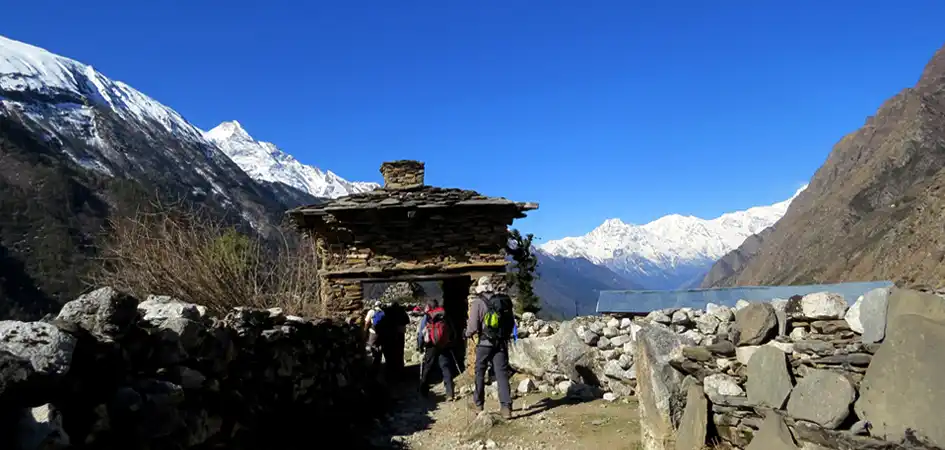
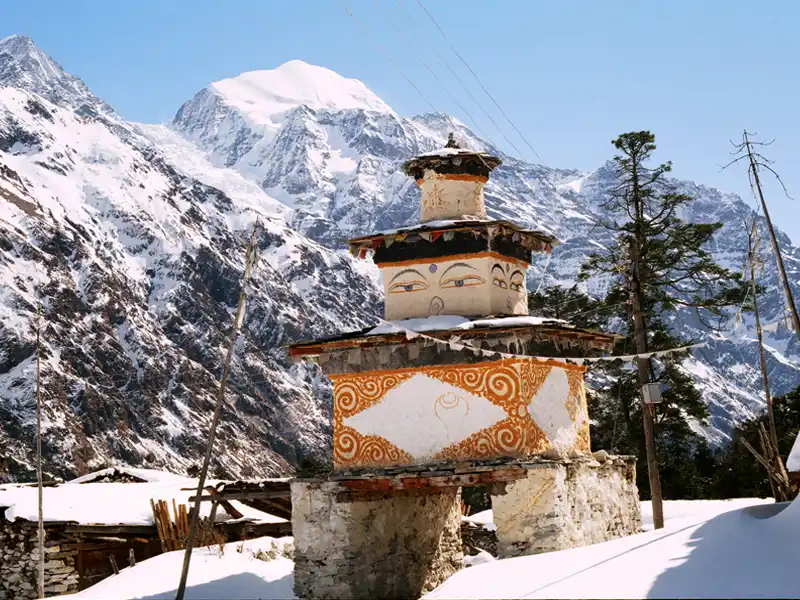
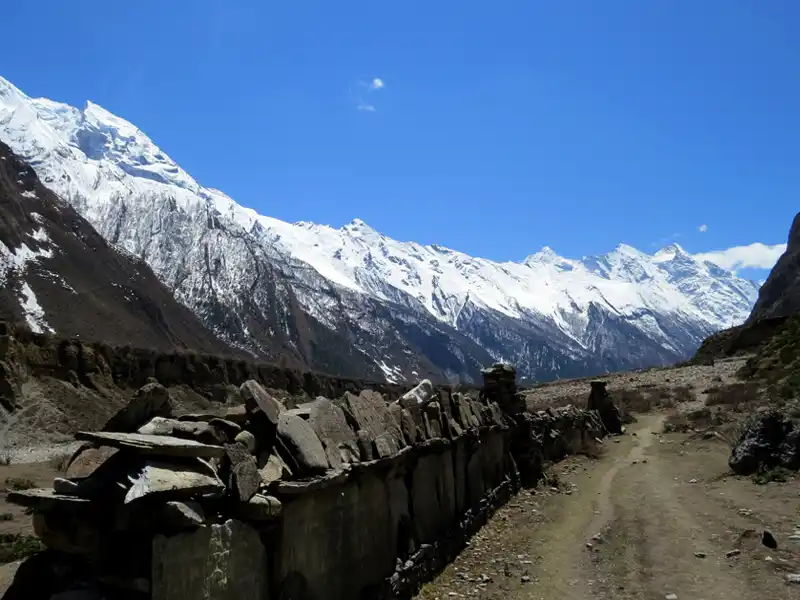
Descend into a gorgeous forest, crossing three streams via bridges. Circle under a towering river bluff and ascend steeply on sturdy but exposed stairs. After approximately 30 minutes, traverse north through pine trees and rhododendrons, continuing to climb with very steep inclines. Ahead lies the alluring hidden valley of Tsum. Finally, descend to the isolated Ghumlong (2,130 m) on the river. The path ahead climbs steeply to Ripchet (2,470 m) in about an hour, while the path to Chumling (2,360 m) crosses the Shiar Khola on a wooden bridge and ascends. After about 30 minutes near Chumling, the trail takes a level route to the right (east) for 15 minutes to reach the final hotel in Tsum. In the evening, visit the old monastery, traditional houses, orchards, clinic, and beautiful stone streets. This is an agricultural area where Buddhism is practiced, featuring conical haystacks made of pine needles and surrounded by prayer flags. From here, trails are lined with decorative chortens and mani walls made of thousands of stone slabs engraved with deities and prayers.
Walk: 4-5 Hours |
Altitude Gain: 710 meters |
Altitude Loss: 310 meters |
Accommodation: Lodge l
Meal: Breakfast, Lunch, Dinner
Head east and cross a suspension bridge to journey through fertile farmland filled with maize and potatoes. Along the way, you will come across a massive landslide that has cleared an area to the opposite bank, now covered in a forest of young trees with stunning views of Mt. Ganesh Himal. Continue your journey by crossing the Serpu Khola and climbing a well-graded but exposed track for 2.5 hours to reach the upper Tsum and the large village of Chhokangparo (3,010 m), where you'll find stone houses tucked under cliffs, with not a single iron roof in sight. The valley opens into vast fields of barley, maize, buckwheat, and potatoes, with herds of Thar often grazing on the rugged cliffs to the north. You can catch an impressive view of Mt. Himalchuli (7,893 m) from the fields in the valley.
Walk: 6-7 Hours |
Altitude Gain: 1,070 meters |
Altitude Loss: 180 meters |
Accommodation: Lodge l
Meal: Breakfast, Lunch, Dinner
Journey east through quaint villages and a local school, trek over a ridge dotted with chortens, and pass Lamagaon (3,202 m) through flat fields with expansive crops and a river view of the grand Rachen Gompa (3,240 m). Hike up to Milarepa's Cave (Piren Phu), where the famous Tibetan Buddhist teacher is said to have meditated. The cave is undergoing restoration. Cross the Shiar Khola, pass by the hamlets of Phurbe (3,251 m) and Pangdun (3,258 m) and an unusual round stupa before reaching the larger village of Chhule (3,347 m) with a distinctive entrance gate. The children here wear traditional Tibetan chubas, and many yaks are in the area. Continue upstream to cross the bridge and hike to the Nile (3,361 m). These villages feature traditional designs with livestock compounds integrated into homes and sheltered verandahs for drying crops. However, the cold weather makes staying in people's houses uncomfortable, and there needs to be more privacy.
Walk: 6-7 Hours |
Altitude Gain: 1,070 meters |
Altitude Loss: 180 meters |
Accommodation: Lodge l
Meal: Breakfast, Lunch, Dinner
The best part of the Tsum Valley trek is the moderate 8-kilometer round trip hike from Nile (3,361 m) to Mu Gompa (3,700 m). The trail goes through a harsh, trans-Himalayan landscape that looks a lot like Tibet. The trail starts at the Nile and goes along the west bank of the Shyar Khola, passing by the ancient Dephyudonma Gompa. It then makes a final, winding climb to Mu Gompa, which was built in 1895 and is the highest and largest monastery in the area. People can look around the main prayer hall, which has a statue of Avalokiteshwara and holy Kangyur texts, while taking in the view of the Ganesh Himal range, which is close to the border with Tibet. To get the most out of this spiritual trip, hikers should get going early to beat the wind, wear layers because the plateau is exposed, and walk clockwise around religious sites to show respect for the culture. On the way back, you can take a detour to the Piren Phu cave near Burji if you'd like to see the holy place where the saint Milarepa meditated.
Walk: 6-7 Hours |
Altitude Gain: 320 meters |
Altitude Loss: 320 meters |
Accommodation: Lodge l
Meal: Breakfast, Lunch, Dinner
The descent from Nile toward Gho is a scenic journey that first leads you on a gentle two-to-three-hour walk south along the Shyar Khola to Rachen Gompa (3,240 m), a significant nunnery of the Ngagyur Nyingma lineage famous for its 1,000 statues of Avalokiteshwara and vibrant murals. After exploring the nunnery and passing through the twin villages of Chhule and Phurbe, the trek continues for another three to four hours, passing through Chhokang Paro and crossing several suspension bridges as the landscape shifts from high-altitude desert to lush pine and rhododendron forests. This significant 755-meter descent brings you to the quiet junction of Gho (2,485 m), which offers stunning views of Ganesh Himal and Shringi Himal and serves as a strategic base for those planning to branch off toward Gumba Lungdang or Ganesh Himal Base Camp via the nearby Dumje trail.
Walk: 5-6 Hours |
Altitude Gain: 70 meters |
Altitude Loss: 860 meters |
Accommodation: Lodge l
Meal: Breakfast, Lunch, Dinner
The trek from Gho to Gumba Lungdang (3,200 m) is a physically demanding yet rewarding transition into the rugged wilderness of the lower Tsum Valley, serving as the primary gateway to the Ganesh Himal Base Camp. This approximately six-kilometer journey begins with a steep descent to the riverbed at Dumje (2,440 m), where you cross the Shyar Khola before embarking on a challenging 715-meter ascent through dense, pristine forests of rhododendron, pine, and juniper. The trail emerges onto a spectacular ridge at Gumba Lungdang, an isolated and historic nunnery that offers a deeply meditative atmosphere and arguably the finest panoramic views in the region, featuring an unobstructed face-to-face look at Ganesh Himal I (7,422 m) and Ganesh II. Staying at the nunnery provides a traditional experience where trekkers can join the nuns for morning or evening puja and stay in basic communal accommodations, making it the perfect final staging point before heading deeper toward the glaciers.
Walk: 5-6 Hours |
Altitude Gain: 1,000 meters |
Altitude Loss: 400 meters |
Accommodation: Lodge l
Meal: Breakfast, Lunch, Dinner
Cross the Lundang Khola on a rickety wooden bridge and begin a steep ascent through pristine pine and rhododendron forests. About halfway up, you'll come across a hut in a kharka. The trail continues behind the hut, leading you up a dry creek bed lined with birch trees. Eventually, you'll emerge onto grassy flats behind the lateral moraine of the Toro Gompa glacier. Continue climbing past seasonal yak huts until you find a trail along the moraine wall. The views of the mountain cirque are superb. The campsite is located in this area. It takes about 4 hours to reach Ganesh Himal Base Camp. We retrace our steps back to Gumba Lungdang in time for the evening puja. The altitude can make this day difficult for some, but the intact forest wilderness and views make it an outstanding trip.
Walk: 7-8 Hours |
Altitude Gain: 1,100 meters |
Altitude Loss: 1,100 meters |
Accommodation: Lodge l
Meal: Breakfast, Lunch, Dinner
This can be a challenging day, so it's best to start early. Descend from Gumba Lungdang on the upward track. Cross the Laudang Khola and stay on the south bank of the Shiar Khola (contrary to the map). Climb over some very deep gorges and shaky cantilever bridges to the picturesque village of Ripchet (2,470 m). Take some time to explore this perched valley, which is fertile and full of barley and buckwheat. Pine forests and chortens line the fields' borders. Descend on steep stairs to the lone local lodge of Ghumlong (2,130 m), which you passed through seven days ago. Climb again through the pristine temperate forest to Lokpa (2,240 m), where you can enjoy a comfortable bed in the lodge.
Walk: 7-8 Hours |
Altitude Gain: 600 meters |
Altitude Loss: 1,100 meters |
Accommodation: Lodge l
Meal: Breakfast, Lunch, Dinner
As we leave the captivating Tsum Valley and pass back under the arch marking our exit, we begin our journey along the trail that encircles Manaslu. We cross the deep gorges of the Bhuri Gandaki River on an iron bridge, surrounded by towering mountains with steep walls. The path takes us through dense forests and rugged terrain, with a changing landscape and vegetation. We pass through quaint villages and wooden bridges, eventually reaching the village of Dyang (Deng), where Tibetan culture is evident in the architecture, locals, and prayer mills. The valley opens up to stunning views of the Lapuchang and Chhachung peaks, which reach nearly 6,000 meters along the Tibetan border. After briefly descending to cross the river, we ascend a steep path to a picturesque balcony trail. Despite the growing number of tourists, we still encounter villagers and mule caravans along the way.
Walk: 5-6 Hours |
Altitude Gain: 725 meters |
Altitude Loss: 640 meters |
Accommodation: Lodge l
Meal: Breakfast, Lunch, Dinner
Continuing along the Bhuri Gandaki River on this side will take us a bit further to the village of Ghap, passing through small, cultivated plateaus. In the afternoon, we will ascend a lovely path with stairs, winding through a lush forest with magnificent giant spruce trees, especially at Suksam. Upon reaching Namrung, a picturesque and tourist-friendly village, there are pastry stalls and lodges for visitors, making it an important stop on the Manaslu trek.
Walk: 5-6 Hours |
Altitude Gain: 990 meters |
Altitude Loss: 360 meters |
Accommodation: Lodge l
Meal: Breakfast, Lunch, Dinner
We follow a beautifully cultivated plateau that winds through the villages of Baksan, Lihi, and Wangsang, with the stunning backdrop of Manaslu in the distance. The scenery changes dramatically as we move higher, with the vibrant fields below giving way to a more rugged landscape. Along the way, we are treated to breathtaking views of Ganesh and Himal Chuli from the village of Shyo, passing by traditional chortens and mani walls. After stopping for lunch in Lho Gaon, we continue our journey, descending towards the river before climbing steeply through a lush coniferous forest to reach Shyala.
Walk: 5-6 Hours |
Altitude Gain: 1,130 meters |
Altitude Loss: 300 meters |
Accommodation: Lodge l
Meal: Breakfast, Lunch, Dinner
We start our journey this morning with an acclimatization hike to the Pung Gyen monastery, pausing before our ascent to higher altitudes. It is going to be one of the most amazing days of our trip. The journey is simple; it leads us gradually away from the rough, dark mountains and onto a tranquil plateau with golden grass and a ring of glistening white snow and ice surrounding it. At an altitude of 3870 meters, the deserted Tibetan monastery is tucked away in this pristine landscape, with the majestic Manaslu towering in the distance. We are enamored with a view that will live forever in our memories as we eat lunch here, amidst distant avalanches and the sound of breaking ice. We retrace our steps, not wanting to lose the breathtaking view, and head toward Sama Gaon, a traditional Tibetan village that is just waiting for us to find it.
Walk: 5-6 Hours |
Altitude Gain: 900 meters |
Altitude Loss: 600 meters |
Accommodation: Lodge l
Meal: Breakfast, Lunch, Dinner
In the morning, we will visit a monastery and then have the chance to hike up to Birendra Kund, a glacial lake located at the base of the Manaslu glacier. Our journey will start with an easy walk to Kermo Manan, where there is a very long mani wall. As we continue through the alpine-style valley, we will gradually ascend towards a typical Tibetan village. After crossing a small bridge, we will encounter a short but steep climb that will lead us to the main attraction of our trip: Samdo, a village with about 200 residents. The influence of Tibet is noticeable in Lajing Banjyang. The people of Samdo, who are of Tibetan descent, have regular trade connections with families and elders in Tibet. We will have the opportunity to explore this charming and welcoming village before taking a rest.
Walk: 3-4 Hours |
Altitude Gain: 450 meters |
Altitude Loss: 150 meters |
Accommodation: Lodge l
Meal: Breakfast, Lunch, Dinner
Leaving Samdo behind, we embark on the ancient trade route towards Tibet. Crossing a bridge, we ascend through the remains of Larkya Bazaar, once a bustling market. As we climb for about three hours, passing glaciers, the panoramic views become increasingly awe-inspiring. Our destination is Dharamsala, the high camp for the Larkya La pass. Here, we pause for a lunch break, relishing the breathtaking vistas surrounding us. Given the altitude and cold, it is advisable to take it easy in the afternoon, prioritizing warmth and rest. An early dinner awaits us as we prepare ourselves for the journey across the Larkya Pass tomorrow.
Walk: 4-5 Hours |
Altitude Gain: 635 meters |
Altitude Loss: 100 meters |
Accommodation: Lodge l
Meal: Breakfast, Lunch, Dinner
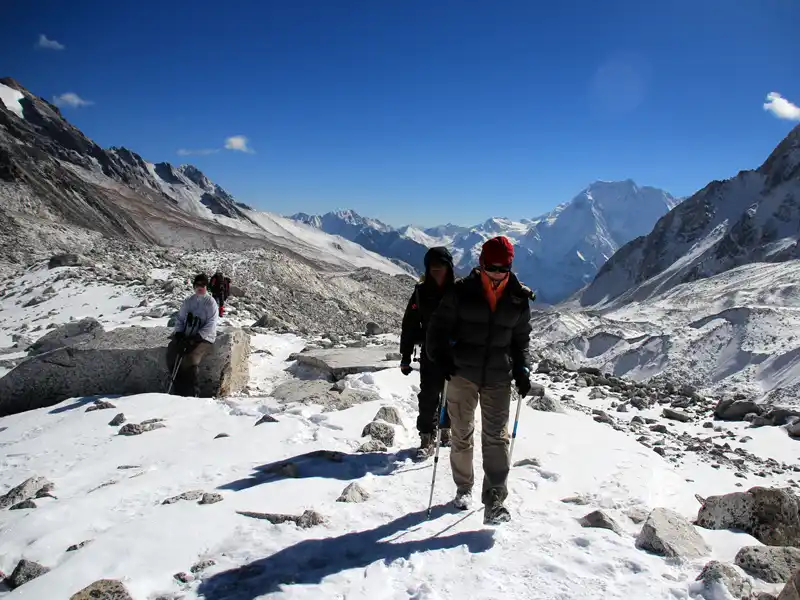
From Dharamshala, we ascend to the ablation valley on the north side of the Larkya Glacier, offering views of Cho Danda and Larkya-La. Traversing the glacier's moraines, sometimes through snow, we gradually climb towards the pass, with the steepness increasing closer to the summit. The ascent typically takes around four hours. At the top, we're greeted with a breathtaking panorama, showcasing Himlung Himal, Cheo Himal, Kangguru, and the majestic Annapurna II. Both sides of the pass offer equally stunning vistas. After adorning the area with Tibetan prayer flags, we embark on a steep and occasionally slippery descent, following a trail along the glacier's moraines. We take a lunch break on smooth rocks below the pass before continuing the descent, which lasts approximately three hours until we reach our campsite. The rocky descent leads us to Bhimtang, an enchanting destination that makes the journey truly worthwhile.
Walk: 8-9 Hours |
Altitude Gain: 770 meters |
Altitude Loss: 1,595 meters |
Accommodation: Lodge l
Meal: Breakfast, Lunch, Dinner
The trek from Bhimtang to Gowa is an exhilarating journey through the stunning landscapes of the Himalayas. Leaving the charming village of Bhimtang, surrounded by lush greenery and towering peaks, you'll follow a memorable trail towards Gowa. The route winds through dense rhododendron forests with colorful blooms, and you'll cross gurgling streams on sturdy bridges, passing quaint mountain communities that welcome you with warm hospitality. As you ascend, the view transforms into a breathtaking display of snow-capped peaks. Finally, in the serene settlement of Gowa, you can unwind and embrace the tranquility of nature. This trek is a true communion with nature, leaving you with cherished memories for a lifetime.
Walk: 5-6 Hours |
Altitude Gain: 100 meters |
Altitude Loss: 1,000 meters |
Accommodation: Lodge l
Meal: Breakfast, Lunch, Dinner
Today signifies the culmination of our trek. Following a 1.5-hour trek, we reached Tilije, a sizable settlement home to the brave Gurung community. The Gurung people have gained recognition for their valor and contribution to distinguished units of the British and Indian armies. Despite their military heritage, they maintain a peaceful way of life and are known for cultivating delectable apples. Subsequently, we continued our descent for another 1.5 hours, tracing the Dudh Khola River until it merged with the Marsyangdi River in Dharapani. This scenic journey led us to the delightful village of Tal after an additional 2 hours of trekking. Here, we shall spend the night, immersed in the charm and tranquility of this picturesque locale.
Walk: 5-6 Hours |
Altitude Gain: 300 meters |
Altitude Loss: 600 meters |
Accommodation: Lodge l
Meal: Breakfast, Lunch, Dinner
Today, we are embarking on a scenic jeep ride from Tal to Kathmandu, covering an approximate distance of 227 kilometers. This journey will lead us through some of Nepal's most rugged and remote terrain, providing a remarkable opportunity to witness the country's diverse landscapes and cultures from a unique perspective. As we traverse through picturesque valleys, winding roads, and mountain passes, we will be treated to awe-inspiring views of snow-capped peaks and pristine rivers. Along the way, we will make occasional stops to stretch our legs and capture photographs of the breathtaking vistas that surround us. Once we arrive in Kathmandu, we will have ample time to unwind and explore the vibrant city at our leisure. Whether we choose to engage in souvenir shopping or partake in other activities, this promises to be an exciting and adventurous day, brimming with unforgettable moments and cherished memories that will endure a lifetime.
Transfer: 227km, 7-8 hours |
Accommodation: Hotel l
Meal: Breakfast, Lunch
Today, we have a free day to explore the vibrant city of Kathmandu on our own. You may want to spend the day indulging in some souvenir shopping, wandering around the colorful streets and bazaars, or enjoying the local cuisine. You could also visit some of the popular tourist attractions in the city, such as Bhaktapur or Patan, which showcase Nepal's rich cultural and historical heritage. Alternatively, you could engage in other activities like hiking, biking, or adventure sports, or simply relax and rejuvenate in one of the city's many spas and wellness centers. Whatever you choose to do, make sure to soak up the unique sights, sounds, and flavors of this wonderful city.
Accommodation: Hotel l
Meal: Breakfast
Today, we will transfer to Kathmandu International Airport for our departure. After enjoying a hearty breakfast at the hotel, we will gather our belongings and make our way to the airport. We will ensure that we reach the airport well in time to complete all the necessary formalities and board our flight. Before we bid farewell to this enchanting country, take one last look at the breathtaking views of the Himalayas and take a moment to appreciate the warm hospitality and kindness of the Nepalese people. This marks the end of our tour, and we hope you had a memorable and enjoyable time in Nepal.
Transfer: 25-30 min l
Meal: Breakfast
The Tsum Valley and Manaslu Trek 2026 cost on the website applies to groups of 6–12 people. However, private trips for groups of two or more can be organized upon request. A group booking of 12 or more people can offer a maximum discount with one free trip. Clients' travel date preferences can be accommodated, but the trek cost depends on group size, duration, accommodation type, and additional activities or services.
- Group Size: The cost of the trip will depend on the size of the group.
- Hotel Accommodation Category and Client's Budget: The cost may also vary based on the accommodation category and budget preference of the client.
- Itinerary Modification: Our trekking itinerary can be modified according to your time and requirements, and the cost will be adjusted accordingly.
- Additional Services: If you require additional services, the cost will be adjusted accordingly based on mutual understanding.
- Trekking Staff: The cost is also affected by the number of Trekking Guides, Assistant Guides, and extra porters required for the trip.
| Trip Dates | Trip Cost | Status | Inquiry |
| USD USD 2,700.00 Per Person | Available | Inquiry |
Cost Includes:
- Airport pick-up and drop-off services in private transportation before and after the trek.
- Hotel Accommodation: 4 nights in Kathmandu at a twin sharing room on the BB plan.
- City Cultural Tour in Kathmandu with the City Tour Guide and all the entrance and monument fees.
- Transportation: Kathmandu—Laprak and Tal—Kathmandu with a Guide.
- Breakfast, Lunch, and Dinner during Tsum Valley and Manaslu Circuit Trek.
- Best available lodges and guesthouses at a twin-sharing room for accommodation during the trek.
- Trekking Staffs: Experienced English-speaking Trekking Guide, Assistant Guide for a group of over six people and porters (2:1), including their daily allowance, meal, and accommodation.
- Accidental and medical insurance for Nepalese team.
- Trekking Permit: Special permit for Tsum Valley and Manaslu, Manaslu Conservation Area Project (MCAP), and Annapurna Conservation Area Project (ACAP) Entry Permit Fee.
- All government-applicable taxes
- Travel agency service charge.
Cost Excludes:
- Lunch and dinner in Kathmandu before and after the Tsum Valley and Manaslu Trek.
- International air ticket.
- Beverage, hard drinks, and alcohol.
- Nepal entry visa fee and airport tax during the departure.
- Extra supporting staff, laundry, battery charge, and communication expenses.
- Personal expenses like tea, coffee, bar bill, drinking water, beverage, snacks, hot shower, etc.
- Travel and medical insurance, emergency evacuation/natural disaster, or personal reasons.
- In any case of natural calamities, mishaps, or anything beyond our control.
- Tips and gratitude for the members of the trekking or the tour.
Please feel free to ask any questions.
1. Why the Tsum Valley and Manaslu Trek?
The Tsum Valley and Manaslu Trek is an exciting adventure in Nepal's remote Himalayas. It highlights the fascinating Tibetan Buddhist traditions as well as the mystical Tsum Valley location. Mount Manaslu, the eighth-highest peak in the world, serves as the focal point of the trek, which offers breathtaking views of snow-capped peaks and towering peaks. The best time to visit is in the spring (March to May) and autumn (September to November), when the skies are clear, the temperatures are pleasant, and the wildflowers are stunning. This trek offers a distinctive viewpoint of Nepal's remote Himalayas and provides an opportunity to explore historic monasteries and prayer wheels that reverberate mantras in the mountain breeze.
2. How difficult are the Tsum Valley and Manaslu treks?
The Tsum Valley and Manaslu Trek is a challenging yet rewarding journey through the Himalayas. To be successful, trekkers must be mentally and physically prepared for the challenges they will face. The trek includes steep ascents and descents, difficult terrain, and high altitudes. All trekkers are expected to be physically fit, with regular strength training and cardiovascular exercise, as well as prior experience trekking in high-altitude areas. Because of the significant elevation gain, altitude sickness is a risk, and adequate acclimatization is required before beginning the trek. This task includes gradual ascent, regular breaks, monitoring of body signals, and hydration. Despite the breathtaking Himalayan landscape and abundant cultural heritage, the Tsum Valley and Manaslu Trek offer an unforgettable experience; however, one must be physically and mentally prepared before embarking on this journey.
3. When is the best time to go on the Tsum Valley and Manaslu Trek?
The best time to go on the Tsum Valley and Manaslu Trek is during the spring (March to May) and autumn (September to November) seasons. During these times, the weather is clear, and the views of the mountains are breathtaking. However, if you prepare adequately, you can also trek during the monsoon season.
4. Do I need permits for the Tsum Valley and Manaslu trek?
Manaslu and Tsum Valley are two places that require you to have restricted area permits, so the answer is yes to both of those questions. The price can vary significantly depending on the time of year. You will also be required to have a permit to enter the Manaslu Conservation Area (MCAP) as well as an Annapurna Conservation Area Permit (ACAP). You can obtain these permits by reaching out to Nepalese trekking agencies registered with the country's government.
5. How does the accommodation for the Tsum Valley and Manaslu trek differ?
On the trekking route, there are various accommodations available, ranging from simple teahouses to more luxurious lodges in certain villages. Tea houses provide reasonably priced meals and dormitory-style rooms with shared bathrooms. Larger village lodges often offer private rooms with attached bathrooms.
6. Is altitude sickness a concern on the Tsum Valley and Manaslu trek?
The Tsum Valley and Manaslu Treks present a significant risk of altitude sickness because they reach heights greater than 5,000 meters. Trekkers should make every effort to avoid rushing up the ascent, take frequent breaks, and ascend slowly to lessen the likelihood of developing illnesses that are associated with high altitude. It is also helpful to avoid caffeine and alcohol, as well as to maintain proper hydration levels. It is essential to seek medical attention at an early stage to identify the symptoms of altitude sickness, which include headaches, nausea, dizziness, fatigue, loss of appetite, and difficulty sleeping. It is highly recommended that you hire a knowledgeable guide to accompany you on a trek. This will help you learn to adapt, track symptoms, and manage crises. Trekkers need to ensure that they are adequately prepared and acclimatized and that they have experienced guides to safely navigate high-altitude terrain and take in the breathtaking scenery of the Himalayas.
7. Are there ATMs or places to withdraw money along the Tsum Valley and Manaslu trek?
There are no automated teller machines or other locations where you can withdraw money once you begin the trek. It is critical to have enough Nepalese rupees in cash to cover your expenses for the duration of the trek.
8. Would it be possible to do the Tsum Valley and Manaslu trek independently?
Since the Tsum Valley and Manaslu Trek in Nepal are in protected areas, trekkers must be with a licensed guide and a group of at least two people. The region safeguards its natural and cultural heritage, ensuring the well-being and safety of its inhabitants. Trekkers must go through a trekking company that is registered with the Nepal government. This company is responsible for organizing guided treks, providing permits, and providing logistical support. Because they offer helpful information regarding local culture, customs, and environment, facilitate interactions with communities, and assist in navigating the terrain, it is highly recommended to hire a licensed guide and porter, particularly in remote areas with limited assistance. This recommendation is especially true in areas where there is limited assistance.
9. What cultural highlights can I expect along the Tsum Valley and Manaslu trek?
The Tsum Valley and Manaslu Trek is a cultural journey that takes travelers through the Himalayan landscape and highlights the spiritual heritage of the region along the way. As it travels through Buddhist monasteries, chortens, and prayer wheels, the trail provides visitors with an opportunity to observe and learn about various religious practices and beliefs. Additionally, it offers the chance to visit traditional Tibetan-style villages home to ethnic groups like the Tsumbas and Gurungs and learn about their way of life in the harsh mountain environment. Trekkers will be able to forge meaningful connections and create memories that will last a lifetime thanks to the warmth and hospitality of the locals, which is sure to leave an impression that will last a lifetime.