Upon your arrival in Kathmandu, Nepal, a friendly representative from Manaslu Trek will greet you at the airport and escort you to your hotel. This marks the beginning of your Everest Three Passes Trek adventure, offering a smooth and comfortable start to your journey in the Himalayan region.
In the evening, we host a special welcome dinner featuring authentic Nepalese cuisine, accompanied by a refreshing reception drink. This welcome evening also provides an opportunity to meet your fellow trekkers, discuss the Everest Three Passes Trek itinerary, and receive essential tips for trekking in the Himalayas, including acclimatization, packing, and safety advice. Starting your journey in Kathmandu allows you to ease into the adventure while enjoying the city’s vibrant culture and setting the stage for your unforgettable Himalayan trekking experience.
Transfer: 30-45 min |
Accommodation: Hotel |
Meal: Welcome Dinner
Today, explore the rich culture, history, and heritage of Kathmandu Valley on this full-day city tour before your Everest Three Passes Trek. The tour takes you to some of Kathmandu's most famous UNESCO World Heritage Sites, offering a perfect introduction to Nepalese art, architecture, and traditions with our professional English-speaking City Tour Guide:
- SWOYAMBHUNATH , also known as the Monkey Temple, is one of Kathmandu Valley’s most iconic Buddhist stupas. Perched on a hilltop, it offers panoramic views of Kathmandu city and features ancient shrines, prayer wheels, and intricate carvings. The site is a spiritual and cultural landmark, attracting both pilgrims and tourists.
- KATHMANDU DURBAR SQUARE is a UNESCO World Heritage Site and the historic heart of Kathmandu City. Known for its ancient palaces, temples, courtyards, and intricate wood carvings, it reflects Nepalese art, culture, and architecture. A visit to this iconic square offers a glimpse into the royal history of Nepal.
- BOUDHANATH STUPA is one of the largest and most important Buddhist stupas in Nepal and a UNESCO World Heritage Site. Known for its massive white dome, colorful prayer flags, and iconic Buddha eyes, it serves as a major center for Tibetan Buddhism. Visiting Boudhanath provides an immersive cultural and spiritual experience.
- PASHUPATINATH is one of Nepal’s most sacred Hindu temples, dedicated to Lord Shiva and located on the banks of the Bagmati River in Kathmandu. Famous for its intricate pagoda-style architecture, cremation ghats, and spiritual rituals, it offers visitors a deep cultural and religious experience.
Our knowledgeable guide will tell you interesting things about the religious, historical, and architectural importance of each landmark. Kathmandu is a unique city with a rich culture and a spiritual atmosphere that will make your city tour an interesting and memorable way to learn about Nepalese heritage.
Sightseeing: 7-8 Hours |
Accommodation: Hotel |
Meal: Breakfast
The drive begins with a pre-dawn drive from Kathmandu to Ramechhap Airport, usually departing between 1:00 and 2:30 AM along the winding BP Highway to catch the morning flight to Lukla. From Ramechhap, you board a small Twin Otter aircraft for a thrilling 15–20 minute flight over the Himalayas, landing at the famous Tenzing-Hillary Airport in Lukla, where you can often see busy loading and unloading activity on the sloped runway. After meeting your porters, the trek officially begins with a gentle descent from Lukla to Phakding, passing through charming Sherpa villages such as Chheplung, Thado, Nurning, and Chhuthawa. Along the well-marked trail, you walk through pine forests, rhododendron sections, suspension bridges, and Buddhist chortens and mani walls, while enjoying views of the Dudh Koshi River valley and sacred Khumbila peak. After about 3–4 hours of trekking covering roughly 10 kilometers, you arrive at Phakding (2,610m), a peaceful riverside village where your Everest trekking journey officially begins.
Note: Since 2020, all flights to and from Lukla have been operating from Ramechhap Airport, east of the Kathmandu Valley, as per the decision of Nepalese aviation authorities. This is done to reduce congestion at Kathmandu International Airport, which has reached its maximum air traffic capacity. The travel time is estimated to be four hours each way.
Transfer: 128 km, 4-5 min |
Flight: 15 min |
Walk: 3-4 Hours |
Distance: 8 km |
Altitude Gain: 170 m |
Altitude Loss: 390 m |
Accommodation: Lodge I
Meal: Breakfast, Lunch, Dinner
After breakfast in Phakding, the trek begins with a scenic walk along the Dudh Koshi River, following the picturesque “Waterfall Route” past the cascading falls of Benkar and the lush orchards of Chumoa before reaching Monjo, the gateway to Sagarmatha (Everest) National Park. Continuing north through Jorsale, the last village before the climb, you’ll cross vibrant, prayer-flag-draped suspension bridges spanning the Dudh Koshi and Bhote Koshi rivers, including the iconic Hillary Bridge at their confluence. From here, the legendary two-hour Namche ascent begins—a challenging uphill trek through fragrant pine forests that rewards trekkers with their first glimpse of Mount Everest from a hidden viewpoint along the trail. Covering approximately 10.5 km (6.5 miles) in about five hours, this breathtaking journey through the heart of the Khumbu culminates in Namche Bazaar, the vibrant “Sherpa Capital,” a natural mountain amphitheater known for its bustling Saturday market, modern bakeries, trekking gear shops, and rich Himalayan traditions set beneath the towering peak of Thamserku.
Walk: 5-6 Hours |
Distance: 10.5 km |
Altitude Gain: 930 m |
Altitude Loss: 150 m |
Accommodation: Lodge l
Meal: Breakfast, Lunch, Dinner
The day’s acclimatization hike begins with a steep, zig-zagging ascent from Namche Bazaar toward Syangboche Airstrip at 3,720 m, where the dramatic peaks of Thamserku and Ama Dablam come into full view. Continuing to the iconic Everest View Hotel, enjoy unobstructed panoramas of Everest, Lhotse, and Ama Dablam, traditionally savored over a cup of lemon tea on the terrace. The trail then descends through the serene "Green Valley" to Khumjung village, where you can visit the Hillary School, see the legendary “Yeti scalp” at the local monastery, and savor a traditional Sherpa potato lunch. The scenic return path skirts the mountainside for an easy descent back to Namche, leaving a free afternoon to relax at a local bakery or the world’s highest Irish pub. The hike not only aids acclimatization, helping prevent altitude sickness, but also immerses trekkers in Sherpa culture while offering breathtaking Himalayan views.
Walk: 5-6 Hours |
Distance: 9 km |
Altitude Gain: 550 m |
Altitude Loss: 550 m |
Accommodation: Lodge l
Meal: Breakfast, Lunch, Dinner
After breakfast in Namche, the trek begins at the western edge of Namche Bazaar, following a scenic, mostly level trail that contours along the hillside. The path offers sweeping views of Thamserku and Kongde Ri, creating a relaxed and picturesque start to the day. Leaving the bustle of Namche behind, the route passes through the quiet, traditional hamlets of Phurte and Samshing, where stone houses and terraced potato fields reflect the simple rhythm of Sherpa life. The trail then dips gently toward Theso before entering Thamo, a peaceful settlement known for its hydroelectric power station and the tranquil Khari Goma nunnery, where the soft sound of Buddhist chanting often drifts through the valley. Continuing onward, the path descends to the Bhote Koshi River and crosses a dramatic suspension bridge spanning a deep gorge, its prayer-flag-lined cables and painted Buddhist deities adding to the spiritual atmosphere. From here, a steady final climb leads to Thame. This historic village, the childhood home of legendary mountaineers such as Tenzing Norgay and Apa Sherpa, sits in a broad alpine valley beneath towering cliffs. High above the village stands the ancient Thame Gompa, one of the oldest and most revered monasteries in the region.
Walk: 4-5 Hours |
Distance: 9 km |
Altitude Gain: 500 m |
Altitude Loss: 140 mrs |
Accommodation: Lodge l
Meal: Breakfast, Lunch, Dinner
After breakfast, we set out from Thame toward Lungden, trekking deep into the quiet Bhote Koshi Valley along an ancient salt-trading route leading toward Nangpa La. Leaving the greenery behind, the trail steadily climbs through a stark alpine landscape where vegetation thins into high-altitude pastures and scrub, offering a sense of isolation and raw Himalayan beauty. Along the way, we glimpse the village of Yellajung across the river and pass through the small seasonal settlements of Tarngga and Chitshing, with impressive views of Kongde Ri dominating the skyline. After a gradual ascent of about 45 minutes, we reach Marlung, a traditional hamlet set beside the glacial river, before continuing through wind-swept terrain marked by mani walls and prayer flags. Walking alongside the rushing Bhote Koshi, the route reveals an authentic side of Sherpa life centered on yak herding and minimal outside influence. After crossing a stream and climbing a small ridge, the final stretch leads us to Lungden at 4,380 meters—a remote high-altitude outpost and the essential staging point for Renjo La, far removed from the crowds of the main Everest trails.
Walk: 4-5 Hours |
Distance: 9.80 km |
Altitude Gain: 620 m |
Altitude Loss: 40 m |
Accommodation: Lodge l
Meal: Breakfast, Lunch, Dinner
After breakfast in Lungden, we begin an early start for one of the most challenging yet rewarding days of the Everest Three High Passes Trek, trekking steadily for about 5 hours toward Renjo La Pass (5,360 m) along an ancient Himalayan salt-trading route that climbs from alpine meadows to rocky switchbacks and frozen meltwater lakes. The high-altitude summit rewards trekkers with breathtaking panoramic views of the Everest region, including Mount Everest, Lhotse, Makalu, and Cho Oyu rising above the vast Ngozumpa Glacier. After a short rest for photos, we descend carefully for 2–3 hours over steep stone steps and loose scree toward Gokyo, following the serene turquoise shoreline of Dudh Pokhari (also known as Milk Lake), completing a spectacular high-altitude journey through one of Nepal’s most scenic Himalayan landscapes.
Walk: 6-8 Hours |
Distance: 11 km |
Altitude Gain: 990 m |
Altitude Loss: 610 m |
Accommodation: Lodge l
Meal: Breakfast, Lunch, Dinner
The pre-dawn ascent to Gokyo Ri typically begins between 4:00 and 5:00 AM, crossing a small stream at the northern edge of Gokyo before climbing a relentless series of steep, rocky switchbacks that require a slow, steady pace in the thinning Himalayan air. After 2–3 hours of strenuous trekking, the prayer-flag-lined summit rewards you with a breathtaking 360-degree panorama of the Everest region, where the iconic Big Four—Mount Everest, Lhotse, Makalu, and Cho Oyu—rise dramatically above the vast Ngozumpa Glacier and the shimmering turquoise waters of Gokyo Lake. Notably, Everest’s northern face is more visible here than from Kalapatthar, making Gokyo Ri one of the finest viewpoints in the Khumbu. After soaking in the unforgettable scenery and capturing photographs, the return journey is a faster but knee-testing descent over loose scree, leading back to the sunlit village for a well-earned breakfast and rest after this challenging yet deeply rewarding Himalayan adventure.
Walk: 6-7 Hours |
Altitude Gain: 560 meters |
Altitude Loss: 560 meters |
Accommodation: Lodge l
Meal: Breakfast, Lunch, Dinner
After breakfast near Gokyo Lake, the trek to Thaknak (Dragnag) begins with a climb from Gokyo onto the shifting lateral moraine of the vast Ngozumpa Glacier, the longest glacier in the Himalayas, where a constantly changing trail winds through a dramatic moonscape of gray rock, loose scree, and sand. Carefully navigating short, steep undulations marked by cairns and paint splashes, trekkers pass deep blue meltwater pools and cross the glacier floor before scrambling up the eastern moraine wall, after which the route levels into an easier walk across sandy flats leading to this quiet staging settlement for the Cho La Pass crossing. Throughout this challenging yet spectacular section of the Everest Three High Passes Trek, hikers enjoy sweeping Himalayan views, including Cho Oyu and Gokyo Ri, making the journey to Thaknak a rewarding high-altitude experience that demands steady pacing and acclimatization awareness.
Walk: 3-4 Hours |
Distance: 3.60 km |
Altitude Gain: 50 m |
Altitude Loss: 120 m |
Accommodation: Lodge l
Meal: Breakfast, Lunch, Dinner
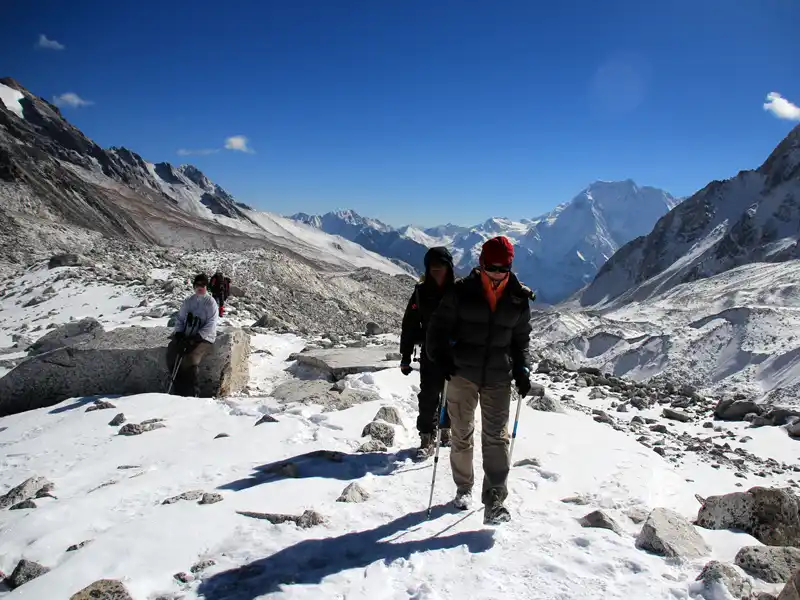
A cold, pre-dawn start marks the challenging ascent from Phedi to Cho La Pass (5,420 m), one of the most demanding and rewarding highlights of the Everest Three High Passes Trek, as the trail climbs steadily through a rocky ravine, loose scree, and a series of false summits navigated by headlamp. Near the top, the route transitions onto the icy surface of the Cho La Glacier, where careful footing is essential on packed snow and slippery rock before a final scramble leads to the prayer-flag-draped summit, offering spectacular Himalayan panoramas featuring Ama Dablam and Cholatse. The descent toward Dzongla is steep and technical, winding through giant boulders and loose moraine before easing into a scenic mountainside trail above the turquoise waters of Cholatse Lake, ultimately rewarding trekkers with breathtaking views of Lobuche Peak and the distant Pheriche valley in this unforgettable high-altitude crossing.
Walk: 6-7 Hours |
Distance: 8.90 km |
Altitude Gain: 760 m |
Altitude Loss: 620 m |
Accommodation: Lodge l
Meal: Breakfast, Lunch, Dinner
After breakfast in Dzongla, the trek to Gorak Shep begins with an easy descent followed by rolling uphill and downhill sections leading to Lobuche, where trekkers pause for lunch. Beyond Lobuche, the trail becomes rockier and more rugged as it winds along the lateral moraine of the Khumbu Glacier, offering spectacular views of the world’s highest peaks, including Mount Everest, Nuptse, Pumori, Ama Dablam, Cholatse, and Taboche. The final stretch involves a steep climb over a rocky ridge before descending into the sandy flats of Gorak Shep at 5,164m, the highest permanent settlement in the region, serving as the essential base for the ultimate trek to Everest Base Camp or a sunrise ascent of Kala Patthar. This high-altitude journey blends challenging terrain with some of the most iconic Himalayan vistas, making it a truly unforgettable experience.
Walk: 4-5 Hours |
Distance: 10.9 km |
Altitude Gain: 470 m |
Altitude Loss: 120 m |
Accommodation: Lodge l
Meal: Breakfast, Lunch, Dinner
The day begins with a pre-dawn departure from Gorak Shep for the sunrise ascent of Kala Patthar, tackling a steep, sandy, and rocky trail where the high 5,000 m altitude makes each step physically demanding. After approximately two hours of climbing, trekkers reach the rocky summit outcrop marked by cairns and prayer flags, where a jaw-dropping 360-degree panorama unfolds, featuring the South Col, Mount Everest, Nuptse, Pumori, and other iconic Himalayan peaks such as Lingtren, Khumbutse, and Changtse. Witnessing the first golden light illuminate the Everest massif provides an unforgettable visual reward. The descent is a fast but jarring scramble, requiring trekking poles for knee protection, before returning to Gorak Shep for a late breakfast. Staying overnight here allows flexibility for a sunset hike in case of poor morning weather while also providing crucial time for active recovery and high-altitude acclimatization before the long journey back down the Khumbu Valley.
Walk: 2 Hours |
Distance: 3 km |
Altitude Gain: 430 m |
Altitude Loss: 430 m |
Accommodation: Lodge l
Meal: Breakfast, Lunch, Dinner
After a light lunch, embark on a high-altitude trek from Gorakshep to the iconic Everest Base Camp, a 3.5 km journey that takes approximately 2 to 3 hours across the rugged Khumbu Glacier’s lateral moraine, navigating shifting rocks, dirt, and glacial ice. The trail ascends gradually, winding through fascinating ice seracs and offering stunning close-up views of the Khumbu Icefall and the base of Mount Everest, with the summit peeking behind the Lhotse-Nuptse ridge. After soaking in the breathtaking scenery, retrace your steps back to Gorakshep for a short rest and lunch, then continue on a 4.5 km trek to Lobuche (4,940m), descending along a more stable valley trail. This challenging yet rewarding day combines endurance trekking with spectacular Himalayan landscapes, from the glacial moraine and icefalls to panoramic views of Everest, making it an unforgettable experience for adventurers seeking the ultimate Everest Base Camp trek.
Walk: 6-7 Hours |
Distance: 12 km |
Altitude Gain: 480 m |
Altitude Loss: 450 m |
Accommodation: Lodge l
Meal: Breakfast, Lunch, Dinner
After breakfast in Lobuche, embark on a challenging high-altitude trek across the Khumbu Glacier toward the Kongma La Pass, navigating a technical landscape of loose scree, ice, and dirt while following stone cairns. The trail climbs relentlessly 630 meters to reach the 5,535 m summit of Kongma La, the highest point of this expedition, where trekkers are rewarded with panoramic Himalayan vistas of Nuptse, Lhotse, and Makalu, along with shimmering frozen lakes. Note that there are no tea houses or water sources along the route, so carrying sufficient water is essential. After conquering the pass, the trek descends steeply through icy sections into the Chhukung Valley, often requiring trekking poles for stability, before leveling out into a gradual walk toward the village of Chhukung, nestled beneath the towering south face of Lhotse, where you will spend the night at a lodge. This trek offers an unforgettable mix of adventure, technical hiking, and breathtaking Himalayan scenery.
Walk: 7-8 Hours |
Distance: 10 km |
Altitude Gain: 630 m |
Altitude Loss: 820 m |
Accommodation: Lodge l
Meal: Breakfast, Lunch, Dinner
After breakfast in Chhukung, begin a scenic descent through the heart of the Khumbu region, transitioning from high-alpine terrain to lush rhododendron and pine forests. The trek starts with a gentle walk from Chhukung to Dingboche, offering stunning victory lap views of Lhotse’s south face and Ama Dablam, before continuing toward Pangboche, home to the oldest monastery in the Everest region. Losing roughly 870 meters in elevation, the air becomes noticeably thicker, making the peaceful hamlet of Deboche an ideal resting point before the final steep 20-minute climb to Tengboche Monastery at 3,865 m. Famous for its spiritual chanting ceremonies and panoramic Himalayan vistas, Tengboche is a highlight of any Everest Base Camp trek itinerary, with golden hour views of Mount Everest and surrounding peaks best captured when arriving by mid-afternoon. The trek also passes the confluence of the Imja Khola and Dudh Koshi rivers, weaving through alpine deserts back into verdant forested valleys, perfectly blending adventure, culture, and breathtaking Himalayan scenery.
Walk: 6-7 Hours |
Distance: 15 km |
Altitude Gain: 180 m |
Altitude Loss: 1,050 m |
Accommodation: Lodge l
Meal: Breakfast, Lunch, Dinner
After leaving Tengboche, the trek descends steeply through lush Khumbu forests along the Dudh Koshi River, offering opportunities to spot local wildlife such as mountain goats, snow leopards, and colorful pheasants. Passing a traditional chorten, the trail leads to the army camp at Namche Bazaar, where trekkers can enjoy one last breathtaking view of Lhotse, the tip of Mount Everest, and the iconic Tengboche Monastery. This dynamic 6-hour segment of the Everest Base Camp trek begins with a steep descent through rhododendron groves to Phunki Tenga, followed by a steady climb back to the bustling hub of Namche Bazaar, ideal for final souvenirs or a bakery treat. From Namche, the trail drops sharply down the Namche Hill, crosses the famous Hillary Suspension Bridge, and passes through the Sagarmatha National Park exit at Jorsale before following the riverbank to reach the village of Monjo (2,835 m). With its challenging up-and-down terrain, this leg demands trekking poles for stability and careful attention to park permits, rewarding trekkers with a safe and scenic conclusion to the high Himalayan adventure.
Walk: 7-8 Hours |
Distance: 15 km |
Altitude Gain: 450 m |
Altitude Loss: 1,470 m |
Accommodation: Lodge l
Meal: Breakfast, Lunch, Dinner
After breakfast in Monjo, the final day of your Everest Base Camp trek retraces your steps through the vibrant lower Khumbu region. The trek begins with a gentle descent from Monjo, crossing the Dudh Koshi River and passing through pine-scented Sherpa villages such as Benkar and Chuthawa, before reaching Phakding for a short tea break. The trail continues through Thadokoshi, offering striking views of Mt. Kusum Kanguru, and winds into the fertile agricultural fields of Chaurikharka, where the landscape shifts from high-altitude wilderness to domestic farmlands. Much of the route follows relatively flat Nepali flats, though the trek concludes with a final 200-meter uphill climb into Lukla, passing the Pasang Lhamu Memorial Gate, which marks the official end of the journey. Crossing suspension bridges over the fast-flowing Dudh Koshi and its tributaries, trekkers arrive in Lukla ready to celebrate their achievement, enjoy local bakeries, or visit the world’s highest Irish pub, reflecting on the unforgettable Himalayan adventure and the breathtaking experiences of the past two weeks.
Walk: 5-6 Hours |
Distance: 13 km |
Altitude Gain: 450 m |
Altitude Loss: 410 m |
Accommodation: Lodge l
Meal: Breakfast, Lunch, Dinner
The final leg of your Everest region trek takes you from Lukla to Kathmandu via Ramechhap, navigating seasonal air traffic challenges at Kathmandu’s airport. After an early breakfast, enjoy a thrilling 15-minute mountain flight from Lukla’s Tenzing-Hillary Airport to Manthali Airport in Ramechhap, offering one last breathtaking aerial view of the Himalayan peaks and deep river valleys. Upon landing, begin a scenic 4- to 7-hour drive along the B.P. Highway, following the Sunkoshi River, winding through terraced hillsides, rural villages, and farmland, providing a glimpse into daily life in the Nepalese lowlands. While the journey can be long and bumpy after weeks of trekking, arriving in Kathmandu brings the welcome comforts of a hot shower, a celebratory meal, and the satisfaction of completing the iconic Everest Base Camp trek. By late afternoon or evening, we arrive in Kathmandu and transfer to the hotel, marking the end of our Himalayan adventure.
Flight: 15 min |
Transfer: 130 km, 4-7 Hours |
Accommodation: Hotel l
Meal: Breakfast, Lunch
Today, we have a free day to independently explore the lively city of Kathmandu. You might consider dedicating the day to souvenir shopping, exploring the vibrant streets and markets, or savoring the local culinary offerings. You may also consider visiting some of the city's renowned tourist attractions, such as Bhaktapur or Patan, which exemplify Nepal's rich cultural and historical heritage. Alternatively, you may participate in other pursuits such as hiking, cycling, or adventure sports, or alternatively, unwind and restore your vitality at one of the city's numerous spas and wellness facilities. Whatever your decision may be, ensure that you immerse yourself in the distinctive sights, sounds, and flavors of this magnificent city.
Accommodation: Hotel l
Meal: Breakfast
Today, we will transfer to Kathmandu International Airport to depart. After a hearty breakfast at the hotel, we'll collect our belongings and head to the airport. We will arrive at the airport on time to complete all of the necessary formalities and board our flight. Before we leave this enchanting country, take one last look at the breathtaking Himalayan views and appreciate the Nepalese people's warm hospitality and kindness. This concludes our tour, and we hope you had a memorable and enjoyable experience in Nepal.
Meal: Breakfast
Everest Three Pass Trek cost on the website applies to groups 6–12 people. However, private trips for groups of two or more can be organized upon request. A group booking of 12 or more people can avail of a maximum discount with one free trip. Clients' travel date preferences can be accommodated, but the trek cost depends on factors such as group size, duration, accommodation type, and additional activities or services.
- Group Size: The cost of the trip will depend on the size of the group.
- Hotel Accommodation Category and Client's Budget: The cost may also vary based on the accommodation category and budget preference of the client.
- Itinerary Modification: Our trekking itinerary can be modified according to your time and requirements, and the cost will be adjusted accordingly.
- Additional Services: If you require additional services, the cost will be adjusted accordingly based on mutual understanding.
- Trekking Staff: The cost is also affected by the number of Trekking Guides, Assistant Guides, and extra porters required for the trip.
Please feel free to reach out to us with any questions or to book your trek.
Cost Includes:
- Airport pick up and drop off on a private vehicle.
- Full-day sightseeing in Kathmandu with English-speaking Tour Guide
- Hotel: 4 nights Hotel accommodation in Kathmandu at twin sharing a room on BB plan.
- Completely lodge trekking, including breakfast, lunch, dinner, and room during the trekking periods.
- Trekking Permit: Sagarmatha National Park and TIMS Card entrance fees.
- All the monuments and entrance fees in Kathmandu.
- Domestic tickets: Kathmandu to Lukla and Lukla to Kathmandu.
- Trekking Staffs: English Speaking Trekking Guide, Assistant Guide, and Porter (2:1 Porter)
- First aid and medical kits
- All government taxes and official charges.
- Accidental and medical Insurance of Nepalese staff.
Cost Excludes:
- Lunch & Dinner in Kathmandu.
- International air ticket.
- Nepal visa fees.
- Rescue/ emergence and insurance cost.
- Beverage and hard drinks and alcohol.
- Nepal entry visa fee and airport tax during the departure.
- Personal equipment and personal expenses.
- In case of natural calamities, i.e. political unrest, flight cancellation due to weather, landslides, etc., the extra charge should be borne by itself.
Please feel free for any queries. Q: What is the Everest Three Passes trek?
A: The Everest Three Passes Trek is a challenging trek in the Everest region of Nepal. It involves crossing three high passes (Renjo La, Cho La, and Kongma La) and visiting several of the region's most beautiful and remote valleys.
Q: How long is the Everest Three Passes trek?
A: The trek usually takes around 19–21 days, depending on your pace and itinerary.
Q: What is the difficulty level of the Everest Three Passes trek?
A: The Everest Three Passes Trek is considered a challenging trek, as it involves trekking at a high altitude and crossing three high passes. Trekkers should have a satisfactory level of fitness and previous trekking experience.
Q: What is the best time of year to do the Everest Three Passes trek?
A: The best time to do the Everest Three Passes trek is from March to May and from September to November, as these months generally have clear skies and favorable weather. You can also trek in other months, but the weather may be less predictable.
Q: Do I need a guide for the Everest Three Passes trek?
A: While it is possible to do the Everest Three Passes trek independently, hiring a guide is highly recommended. A guide can help you navigate the challenging terrain, ensure your safety, and offer important information about the local culture and environment.
Q: What permits do I need for the Everest Three Passes trek?
A: To do the Everest Three Passes trek, you will need a Sagarmatha National Park permit and a Khumbu Pasang Lhamu Rural Municipality permit. These can be obtained in Kathmandu or at the park entrance in Monjo.
Q: What kind of accommodation is available on the Everest Three Passes trek?
A: Accommodation on the Everest Three Passes trek ranges from basic teahouses to more comfortable lodges. The quality of accommodation varies depending on the location, with more basic facilities at higher altitudes.
Q: What should I pack for the Everest Three Passes trek?
A: Some essential items to pack for the Everest Three Passes trek include warm clothing, a good-quality sleeping bag, a waterproof jacket and pants, sturdy trekking shoes, sunglasses, a hat, and a first aid kit. It is also recommended to bring a reusable water bottle and a water purification system.


 Everest Three High Pass Trek